MCLA-117: a published within-patient escalation ladder
The Cycle 1 dose escalation scheme, and what it settles for this design
Transcribed from an image of the poster, not from the poster. Check every number below against the source before citing it. Links are on the references page.
MCLA-117 (tepoditamab) is a CLEC12A x CD3 bispecific antibody. Its first-in-human phase 1 study in relapsed or refractory acute myeloid leukaemia (AML; NCT03038230) escalated within patients across four orders of magnitude. Section 6 of the working specification cites it as precedent.
The Cycle 1 Scheme
| Cohort | D1 | D3 | D5 | D8 | D11 | D15 | D22 |
|---|---|---|---|---|---|---|---|
| 1 | 25 µg | 50 µg | 100 µg | 200 µg | 300 µg | 450 µg | 675 µg |
| 2 | 100 µg | 200 µg | 400 µg | 750 µg | 1000 µg | 1250 µg | 1500 µg |
| Cohort | D1 | D4 | D8 | D15 | D22 |
|---|---|---|---|---|---|
| 3 | 300 µg | 1 mg | 2 mg | 2 mg | 2 mg |
| 4 | 600 µg | 2 mg | 6 mg | 6 mg | 6 mg |
| 5 | 600 µg | 2 mg | 9 mg | 9 mg | 9 mg |
| 6 | 1 mg | 3 mg | 15 mg | 15 mg | 15 mg |
| 7 | 1 mg | 3 mg | 15 mg | 25 mg | 25 mg |
| 8a | 1 mg | 3 mg | 25 mg | 40 mg | 40 mg |
| 8b | 3 mg | 10 mg | 25 mg | 40 mg | 40 mg |
| 9 | 5 mg | 15 mg | 25 mg | 60 mg | 60 mg |
| 10 | 5 mg | 15 mg | 25 mg | 120 mg | 120 mg |
| 11 | 5 mg | 15 mg | 25 mg | 240 mg | 240 mg |
| 12 | 5 mg | 15 mg | 25 mg | 400 mg | 400 mg |
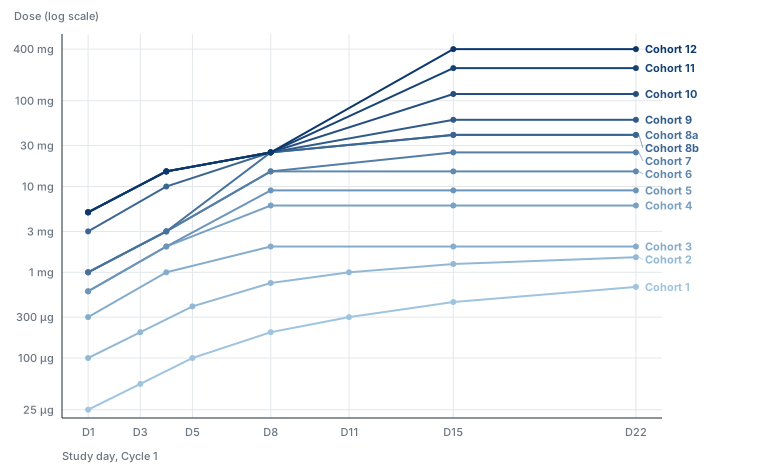
Four Features That Bear on the Design
A within-patient ladder across four orders of magnitude has been run. The programme went from a 25 µg first dose to a 400 mg target dose, a factor of 16,000, so scout-and-backfill does not need to argue that a long ladder is possible.
The number of within-patient steps was not capped. Cohort 1 received seven doses in 22 days and ended 27-fold above its own first dose. The specification’s rejection of a rule such as “maximum three escalations” describes what this trial already did.
The first dose moved slowly while the target dose moved fast. Across the thirteen cohorts the D1 doses are 25, 100, 300, 600 and 600 µg, then 1, 1, 1, 3, 5, 5, 5 and 5 mg. The largest increase in the D1 dose is 4-fold and most are 3-fold or less, while the D22 dose rises from 675 µg to 400 mg over the same cohorts. The constraint is on the first dose to a drug-naive patient, and the ladder above it is free. Section 6 of the specification builds the scout-entry rule on this.
From cohort 9 the step-up prefix is fixed and only the target dose changes. Cohorts 9 to 12 all give 5, 15 and 25 mg on D1, D4 and D8, and differ only in the D15 and D22 target: 60, 120, 240 and 400 mg. Section 7 assumes the same structure for the backfill regimen, a fixed step-up prefix with an escalating target, and MCLA-117 reached it empirically.
Features 2 and 4 supply real values where Sections 13 and 15 carry assumptions: an escalation multiplier of about 2 to 3-fold per step, and five to seven steps inside a 28-day cycle.
Where the Precedent and the Simulated Design Differ
The step interval. Cohort 1 doses on D1, D3, D5, D8, D11, D15 and D22, so its first intervals are 2 and 3 days. Scout-and-backfill holds the interval at one week, so the simulated ladder is slower than the precedent and any acceleration it reports is conservative on that axis. v1 assumes 7 days because the safety gate in Section 15 and the PD turnaround in Section 11 already support it. A sub-weekly scout ladder is a later question.
Redrawing the Figure
make_escalation_figure.py draws the figure above and in Section 6, and carries the dose table as its data. Change the table there and re-run it.